Posted: Sun Jul 27, 2008 11:39 am Post subject:
Test files for ambio processor development
Here are a couple of test files developed by Robin Miller to aid in the development of ambiophonic processors.
One is a recording of Robin speaking and panned left, right, and center. This is a good test of the processors with and coloration.
The other file is a dirac pulse at 44100 Hz. Play this though your processor and record the output. Robin has agreed to analyze these output files on his system.
The ultimate verification is, of course, the sonic results.
I guess the Dirac test/verify is for the RACE version, and not yours?
Well, it is for virtually anything. Record the impulse response and you have a way of analyzing the processor. _________________ --Howard
my music and other stuff
You mean Robin Miller will analyze a Dirac processed by your version of the ambiophonic processor? (it wil have a totally different impulse response than the RACE one)
Edit: if not perhaps you can generate a test file, using your VST, from that Dirac pulse?
Of all the different ambio plugins I have tested they all seem to have a slight issue, unless it is intentional.
Using the l-r-c track, when I hear the L or R vocal, the "s" from stage originates from the center. It is a bit distracting and not sure if it is intended but it smears the location. Like I said they all seem to do it, past and present ones.
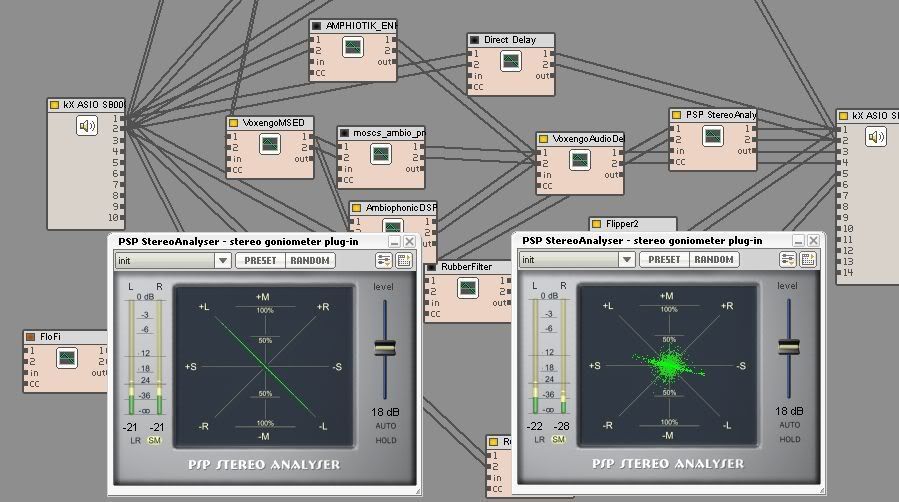
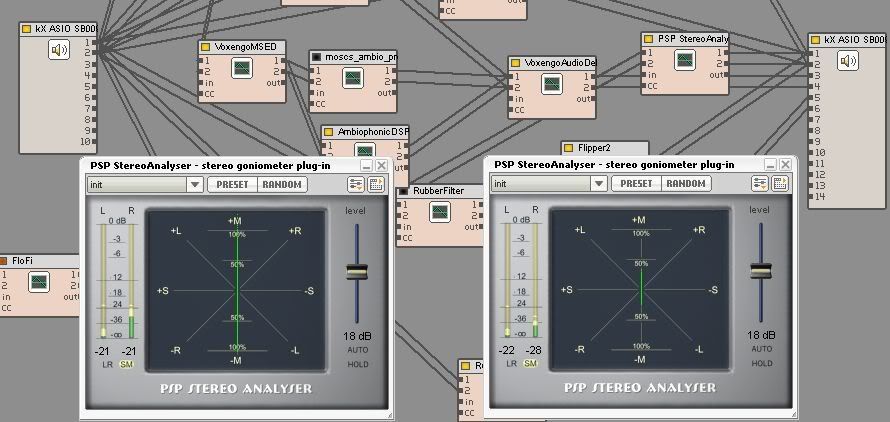
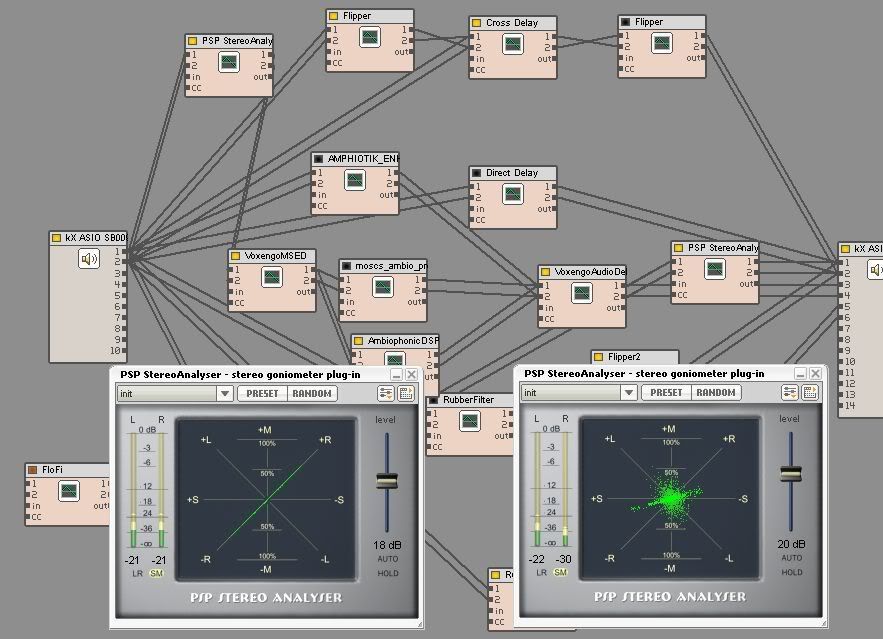
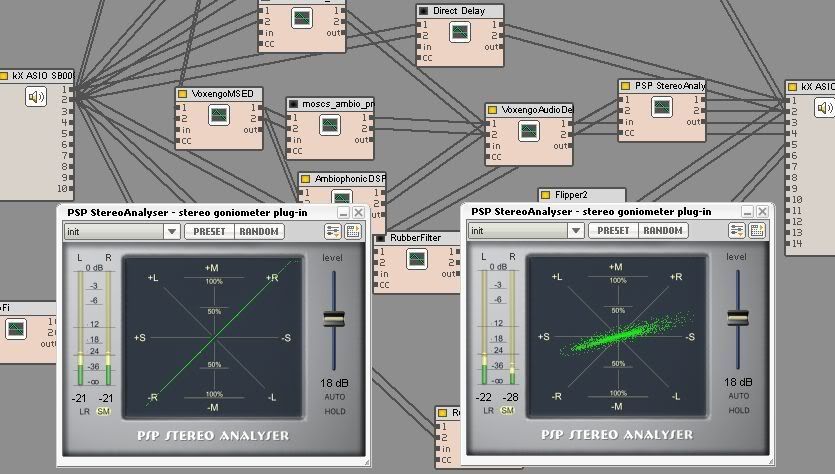
To verify I wasn't crazy, I monitored it with a stereo goniometer both before and after the plugin and it is visible in the meter too, only on the output side. Singal going in is intact. Can this be corrected?
I also noticed the center location is very precise, but the L an R are not as precise. Again input side is good, output is where I notice it. Is this an artifact or intentional to give it more ambiance? No adjustment I could do seemed to correct it.
Of all the different ambio plugins I have tested they all seem to have a slight issue, unless it is intentional.
Using the l-r-c track, when I hear the L or R vocal, the "s" from stage originates from the center. It is a bit distracting and not sure if it is intended but it smears the location. Like I said they all seem to do it, past and present ones.
To verify I wasn't crazy, I monitored it with a stereo goniometer both before and after the plugin and it is visible in the meter too, only on the output side. Singal going in is intact. Can this be corrected?
I also noticed the center location is very precise, but the L an R are not as precise. Again input side is good, output is where I notice it. Is this an artifact or intentional to give it more ambiance? No adjustment I could do seemed to correct it.
You aren't crazy, at least with respect to your observations about ambiophonic reproduction. If the source material is only on the left or right, you will always have another signal on the opposite channel after processing through an ambiophonic processor. This opposite signal is, to zeroth order, delayed and inverted. The psychoacoustic effect is to move the sound far left or right, beyond the width of the speakers.
Your comment about the "s" sounds being centered is an interesting comment. I've noticed some similar effects from time to time. I believe there are some problem with whitish noise signals. Conversely, when you use wide spaced speakers, such whitish noise signals intended to be in the center seem to come directly from the speakers as opposed to sounding like they are from the center.
It seems that conventional stereo creates distortion with the "center" signals. Ambiophonic provides a much more accurate center at the expense of some distortion on the sides. However, ironically the sides in the ambiophonic case are wider and freed from the speakers.
To me, ambiophonic reproduction is much more enjoyable than conventional stereo. _________________ --Howard
my music and other stuff
Yep I understand both speakers work in conjunction with each other to move the location around just as with ambisonics.
I need to try to capture screen shots on the goniometer though maybe to explain the centered 's' on non-centered signal. I don't think that should happen and if we could improve that I would feel much better about it. I hope it is not a necessary evil, it's a wee bit distracting and maybe not totally noticeable or masked with complex music but now that I know it is there I can't miss it.
I was able to capture what I was talking about. Two things.
1) The centering of the beginning and ending of the word "stage" only on the output side when supposed to be L or R
2) The diffuse/loose L and R rather than a strongly defined L or R. Maybe this is needed for ambiance? I wonder if it could be too coloring for some folks?
The good is you can see the output is wider than the stereo signal and since the speakers are more centralized and away from walls it sounds wider than the stereo signal even though stereo speaker placement is already set further apart.
What you are seeing is the effect of whitish noise in the word "stage". Imagine, for discussion, that you play white noise in the L channel and the same signal delayed by some small amount in the R. Your stereo vector scope should show a perfect X pattern, but it will probably not. Instead you might see a fuzzy X with a cluster in the center.
A vertical line on the vector scope indicates the same signal in the L and R channels (mono or uncorrelated). It might be expected that as the signals are noise, they will randomly be exactly the same, or close to the same. This distribution will explain the "globular cluster" in the center and the fuzziness of the images. _________________ --Howard
my music and other stuff
2) The diffuse/loose L and R rather than a strongly defined L or R. Maybe this is needed for ambiance? I wonder if it could be too coloring for some folks?
This is essential for the ambiophonic imaging to work. As for coloring - careful testing will show that conventional stereo provides detrimental coloring too. In the conventional stereo, it is the center stage that is colored because of the destructive comb filtering caused by the cross talk delay between the two speakers. In ambiophonic, the center is much improved, as stated before, and the sides may be colored, but enhanced as well.
These colorations can't really be measured on the audio signals; you must use a microphone in an anechoic chamber to do so properly. _________________ --Howard
my music and other stuff
Joined: Feb 03, 2003 Posts: 42 Location: Bethlehem PA 18018 USA
Posted: Tue Mar 23, 2010 12:07 pm Post subject:
One of several things may be going on...
Quote:
What you are seeing is the effect of whitish noise in the word "stage". Imagine, for discussion, that you play white noise in the L channel and the same signal delayed by some small amount in the R. Your stereo vector scope should show a perfect X pattern, but it will probably not. Instead you might see a fuzzy X with a cluster in the center.
1) Howard's post describes what to expect on a vectorscope re the pseudo-random signals normal in XTC - has anyone done the experiment and compared the vectorscope results?
2) Beyond the objective vector display, if subjectively the "s" or "g" in "stage" (bursts of high energy HF similar to white noise) always is _heard_ centered no matter which XTC process you're using, one might check whether something other than the processor - e.g. HF crosstalk in the power amplifier? (Haven't had this exact observation reported before, nor experienced it myself in the lab);
3) Note that some processors purposely only XTC 300~6kHz where it is most effective and least artifact-producing: LF only make the woofers fight, and layout distances at HF wavelengths are too critical to work reliably (so sibilance >6kHz would be output in phase, therefore centered);
4) "L" or "R" not imaging precisely is also a function of asymmetrical acoustics or non-identical loudspeakers, especially in terms of phase response (timing) through any crossover region(s). Unless perfect, every setup works a little different in this regard. Acoustical reflections can trump it all.
5) I'd only add that the new plug-in is more controllable in all these regards, although the "space" control above 30 or so causes for some increasing fuzziness at the sides, depending also on source material. _________________ Robin Miller
I can duplicate durwood's results as far as the appearance of the vector scope goes. But like you say, Robin, there's nothing unexpected. _________________ --Howard
my music and other stuff
Posted: Thu Jul 14, 2011 8:32 am Post subject:
Re: Test files for ambio processor development
mosc wrote:
Here are a couple of test files developed by Robin Miller to aid in the development of ambiophonic processors.
One is a recording of Robin speaking and panned left, right, and center. This is a good test of the processors with and coloration.
The other file is a dirac pulse at 44100 Hz. Play this though your processor and record the output. Robin has agreed to analyze these output files on his system.
The ultimate verification is, of course, the sonic results.
I only recently became interested in ambiophonics so I'm a little late to this discussion. Nonetheless, dirac-pulse.wav appears to have been normalized, filtered, and dithered making it rather useless for test purposes.
Joined: Feb 03, 2003 Posts: 42 Location: Bethlehem PA 18018 USA
Posted: Fri Jul 15, 2011 6:08 am Post subject:
Quote:
Nonetheless, dirac-pulse.wav appears to have been normalized, filtered, and dithered making it rather useless for test purposes.
The test file dirac-pulse.wav contains "a momentary (one sample) non-zero event" - the definition of a Dirac pulse - that reveals any filter's impulse response. In the case of a crosstalk cancellation filter such as the AmbioDSP plug-in, the cancellation impulses seen are in general channel-alternating and phase-alternating at a periodicity corresponding to the user-adjusted inter-aural delay determined by the loudspeaker layout geometry. For typical layout delays, see the AmbioDSP user guide at http://www.filmaker.com/products.htm (along with illustration of stereo v Ambio geometry and how it affects Listener Envelopment, LEV.). Note that that AmbioDSP plug-in has other user-adjusted filter characteristics to correct for the perceptual errors inherent in ordinary crosstalk cancellation implementations. _________________ Robin Miller
Nonetheless, dirac-pulse.wav appears to have been normalized, filtered, and dithered making it rather useless for test purposes.
The test file dirac-pulse.wav contains "a momentary (one sample) non-zero event" - the definition of a Dirac pulse - that reveals any filter's impulse response.
Attached is a hex dump of the beginning of the file and an Audacity screen shot of the pulse in one channel. The amplitude of the pulse is less than maximum suggesting the file was normalized. The pre- and post-ringing is indicative of a filter. The low level noise seen in the hex dump is indicative of dither and persists throughout the file.
hex.png
Description:
Filesize:
93.8 KB
Viewed:
1200 Time(s)
This image has been reduced to fit the page. Click on it to enlarge.
wav.png
Description:
Filesize:
75.23 KB
Viewed:
1173 Time(s)
This image has been reduced to fit the page. Click on it to enlarge.
Joined: Feb 03, 2003 Posts: 42 Location: Bethlehem PA 18018 USA
Posted: Fri Jul 15, 2011 7:54 am Post subject:
Quote:
The amplitude of the pulse is less than maximum suggesting the file was normalized. The pre- and post-ringing is indicative of a filter. The low level noise seen in the hex dump is indicative of dither and persists throughout the file.
The test file signal was made on purpose conservatively below FS (full scale) so users would be less likely to experience clipping the DUT (device under test) - the result can simply be scaled up if you need a precise IR amplitude. Ditto bandwidth limiting for 44.1kHz use in order to avoid troubling out-of-band artifacts due to aliasing - properly showing up as pre-post "ringing." Dithering (triangular, as the file was made at 32 bit resolution and converted to 16 bit for use) is acceptable engineering practice as it affects only the least significant bit. Of couse anyone may create their own version, but please note that it is a theoretically perfect Dirac that would be useless for the intended purpose of general testing in the real world. _________________ Robin Miller
Then you should have identified the file as a normalized, filtered, and dithered, Dirac-like pulse. It isn’t "a momentary (one sample) non-zero event” as you claim.
A theoretically perfect Dirac pulse is exactly what’s needed for real world testing. If the system I’m testing clips, I’d like to know about it. An impulse response is not something you’d want to listen to. For that reason, limiting the bandwidth and adding dither to the pulse is not only unnecessary, but renders the impulse response useless for its intended purpose.
BTW, your terminology is little mixed up. Aliasing is when a frequency higher than the Nyquist frequency is converted to an ‘alias’ that is lower than the Nyquist frequency. It only happens during the analog-to-digital conversion, hence the need for an anti-alias filter before the D/A.
Finally, a casual look at the hex dump shows occasional sample values of 2 and -2. That means the added dither occupies two LSB, which is twice what you claim.
You cannot post new topics in this forum You cannot reply to topics in this forum You cannot edit your posts in this forum You cannot delete your posts in this forum You cannot vote in polls in this forum You cannot attach files in this forum You can download files in this forum


 Forum index » How-tos » Ambiophonic Sound Reproduction


 FAQ
FAQ Calendar
 Search
 Memberlist
 Usergroups
 Register
 Profile
 Log in to check your private messages
 Log in
 Chat Room