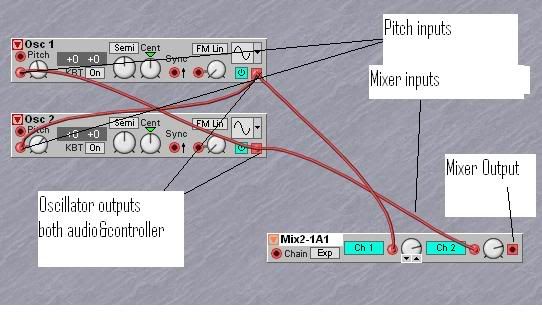
Take two voltage controlled oscillators - called A and B.
Take the output of A and plug it into the FM input of B and plug the output of B into the FM input of A. That's cross modulation.
Run each modulation input through an attenuator or an amplifier. The important thing is that these are modulation index controls for the two oscillators.
Mix A and B and send to the output (could go through filters, envelope generators, effects, etd).
If you use a keyboard, you can connect one or both to the keyboard.
Controls are the 2 freq knobs, 2 modulation indexes, waveforms and the mix of the two oscillators.
For two years, this was just about the only patch I used on the NM1. I use it on the Moog Modular - wonderful. It makes beautiful harmonics. It is also a chaotic system - very difficult to predict what will happen with the modulation indexes are cranked up. Depending on your temperment, you will either love or hate this. Can you tell how I feel?
Mosc, I was deeply into cross modulation patches on my Digisound 80 modular. The wonderful long equillibriums, the surprises and pure madness of it - yes, I can tell how you feel
While, I'm here: the "Modular Synthesis" section is a great idea!
May I respectfully suggest that we post MP3 files for examples, not product specific ones?
DJ
-- Last edited by DrJustice on Wed Jul 27, 2005 3:51 pm; edited 1 time in total
Don't forget that you can connect more than two oscillators. For example by chaining them ouput to input in a ring. Then you can tap the signal in many places. By carefull tweaking you can get extremely complex and pleasing sounds.
Soemething like the below may be a starting point. Some of the cv inputs could be from a keyobard or they could be static - or anything, its a modular!
Code:
+----------------------------------------------------+
| |
| +--------+ +--------+ +--------+ |
| | OSC 1 | | OSC 2 | | OSC N | |
| ..>|cv | ..>|cv | ..>|cv | |
+--->|fm out+--+-->|fm out+--+-...-->|fm out+--+
+--------+ | +---+----+ | +--------+ |
| | |
tap 1 tap 2 tap N
More complexity can be had by setting up further fm routings in interesting arrangements. Adding a bit of delay in some of the fm paths is interesting. Using low frequencies (LFO range) and perhaps some processing modules can result in interesting patterns.
Now think further, think noodles, you may know them?
Yes X modulated LFO's are fun for noodles. Often I quantize the modulations for that, mostly in "voltage", but time quantization (with (using clocked delays) or without (using s&h's) delay)) can be used as well.
I won't even say what equipment I used to keep it "not product specific". I will say that there was no delay used. This is a realtime improv made using just two socillators, two LFOs, multimode filter, one multiplier, two phase shifters and a touch of reverb. _________________ --Howard
my music and other stuff Last edited by mosc on Thu Jul 28, 2005 8:30 am; edited 2 times in total
the thing i like about the nord patches is that they are generally understandable as a block diagram as well as being audiable. when i post little examples,i've been using the g2 demo software (free) so as to avoid using modules that those without the hardware version can't use. i would recomned that everyone who can possibly run the demo (and i've run it on very underpowered pc's) download it, it's very useful for testing small ideas quickly.
Thanks, Paul. A nocturn is art for the night. I guess it should be spelled nocturnE. An aubade is a piece for the morning. I've never written one of those. In fact, I just looked it up.
A good challenge to write an aubade using cross modulation. .
Sorry to butt in! I just needed to say that this thread reads like some kind of technical conversation between Data and LaForge.
DATA: "Do you think cross-modulating the tachyon flow whilst discombobulating inverse phase frequency arrays using the fundamental wavetable output of the universe will thwart the evil Vocodions?"
DOVDER: "No. I think shooting them to death is probably the answer."
I know pseudo-science speak has been done before on this forum but I couldn't resist. _________________ This message was brought to you from Beyond The Grave.
Joined: Aug 12, 2004 Posts: 466 Location: Los Angeles, CA. USA
Posted: Thu Jul 28, 2005 4:12 pm Post subject:
Great topic.
I have always loved the sound of Cross Modulation.
It took me years to find out what it was and how to achieve it.
Finally when I purchased my Roland Jupiter-6 I found what I was looking for. It has some very serious potential especially when used in conjunction with the oscillator sync function for those looking for such things.
Just a bit of extra info on Xmodulation.
It's the classic application of chaos theory in music.
By using the output of a linear system to control the second linear system which controls the first we create very complex patterns from two very predictable sources. The relative frequencies of each will determine the likelihood of true chaotic behaviour.
Also the 2 extra frquencies produced are F1-F2 and F1+F2. The F1-F2 bit is what a theramin uses to create an audible tone from 2 Radio fequencies
See ya,
Andrew _________________ What makes a space ours, is what we put there, and what we do there.
I don't want to be nit pickey but that is a bit of an oversimplification. The sum and difference frequencies are generated when you use a multiplier circuit. The frequency components from frequency modulation are more complex. The results are different when you use linear (Chowning/DX7) exponential FM (used in most modular synths). FM is so complicated at large modulation indexes that it's very difficult to get an intuitive feel for it. _________________ --Howard
my music and other stuff
You cannot post new topics in this forum You cannot reply to topics in this forum You cannot edit your posts in this forum You cannot delete your posts in this forum You cannot vote in polls in this forum You cannot attach files in this forum You can download files in this forum


 Forum index » Instruments and Equipment » Modular Synthesis


 FAQ
FAQ Calendar
 Search
 Memberlist
 Usergroups
 Register
 Profile
 Log in to check your private messages
 Log in
 Chat Room